We sat down with the Chocolate Artisan herself, Jessica Pedemontfor sometips on achievingprofessional results withchocolate.Jessicahelpfullyprovidedus with a wealth of information on all things chocolate, which she generously allowed us to share with our readers. lypes of Chocofate Couverture For a rich chocolate flavour, only the best quality couverture should be used. Couverture (or pure eating chocolate) must be made from pure cocoa nib, cocoa butter, and sugar. To create milk chocolate, milk, cream, and/or milk fat are added.
To remove most of its water content, the millis either condensed or dried. The resulting product is called milk crumb. Flavouring (mainly vanilla). stabilisers and emulsifiersmaybe used. So calledwhite'couverture(contains no chocolateliquor, therefore is not considered true chocolate)consists of cocoa butter, sugar and milk. When couverture is being manufactured, it is exposed to an enormous amount of pounding. grinding, refining and conching. resulting in a very smooth, fine chocolate. This chocolate is then tempered, run into moulds, then passed into coolers.
After de-moulding, the couverture is wrapped for sale. By using a different isproduced in various sizes of button shapes or pieces, and packed Couverture must be stored in a cool, dry place. Under favourable conditions, dark couverture improves with some ageing. Under unfavourable conditions, the full, fresh aroma deteriorates rapidly. The above descriptions are globally used by the confectionery industry, and also form a legal point if a product is sold as couverture.
CompoundedChocolate Tempering is not required, as the cocoa butter has oil,knownaslauricfats.Compoundedchocolateislowerin cost, has a better heat resistance, and is very easy touse. Compounded chocolatemustbelabelledas such. Avoiding Imperfections Sugar Bloom Sugar bloom also appears as a greyish coating on the surface of the chocolate. Unlike fat bloom, it isn't greasy to touch. When magnified,minute sugar crystals are visible. Its crystallised appearance(frosting)is quite rough totouch and effect both milk and dark chocolate.
CommonCausesof SugarBloom::Humid storage conditions (above 80% humidity) for too long Migration of moisture from centres (usually soft fondant), When moulds, equipment or packaging are not completely dry Use of hygroscopic ingredients (low grade or brown sugars)
Sugarbloom is also formed when the jump intemperature between cold storage (1o degrees and below) and the removal from storage (2O degrees and more) is too great. If a difference of about 8 degrees is exceeded, intermediate storage is necessary. When water (condensation) settles on the surface, it will dissolve some sugar from the chocolate. Upon evaporation, this sugar and crystallises remains on thesurface. Fat Bloom Fat bloom appears as a grey coating, streakiness, or dots on the surface of the chocolate.
It is greasy to touch and is easily rubbed off. Upon magnification, minute fat crystals are visible. Some of the causes of fat bloom include::Badtemperingofchocolate: Insufficient of melting or holding at that temperature. The presence of low-melting fats in the centres (nut oils): Storage area temperatures too high or fluctuating too much: The addition of fat from coated centres (hazelnut or filings containing hazelnut oil or coconut paste encourages the formation of fat bloom) Fat bloom is more noticeable on dark chocolate than on milk chocolate.
Understandling the Importance of Cocoa Butter Cocoa butter is essentially the natural fat of the cocoa bean. An understanding of cocoa butter and its various forms is vital if one is to work successfully with chocolate. Usually obtained by the hydraulic expression of cocoa nib, it is light yellow in colour and has a distinct brittle fracture below 20 degrees. The cocoa butter and tempered chocolate begin to This means that chocolate is generally either solid or liquid.
We expect chocolate to melt in our mouth, not in the hands As the complete melting point is just below body temperature (37 degrees) it gives the impression of cool- ing the mouth as it melts. as the change from solid to liguid The melting and crystallisation characteristics of cocoa Cocoa butter is a mixture of glycerides which are polymorphic (polymorphic means 'of many forms). This means that cocoa butter is a mixture of several forms of fat.
Therefore, several crystalline arrangements can exist in cocoa butter, each with its own characteristic melting point Of these crystalline arrangements, only one is stable and the remainder are unstable:: Gamma (G) - very unstable, melting point 17 degrees.: Alpha (A) - unstable. melting point 21 - 24 degrees.: Beta Prime (B1) - unstable, melting point 27 - 29 degrees.: Beta (B) - stable, melting point 34 - 35 degrees. In the process of tempering chocolate, it is aimed to initiate a process where Gamma transforms to Alpha, which then changes to Beta Prime and ultimately to mainly stable Beta crystals.
This is primarily as specific creation for high-melting. stable crystal modifications of the cocoa butter in order to obtain optimum gloss, a crisp break, optimum melting be- haviour and fat bloom resistance for a solidified chocolate. The assistance of very small cocoa butter crystals of equal size guarantees a micro-fine structure in the finished chocolate
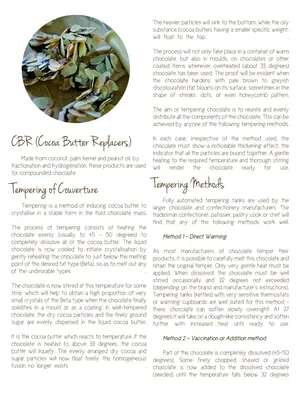
CBR (Cocoa Butter Replacers) Made from coconut, palm kernel and peanut oil, by fractionation and hydrogenation, these products are used for compounded chocolate. Tempering of Couverture Tempering is a method of inducing cocoa butter to crystallise in a stable form in the fluid chocolate mass. The process of tempering consists of heating the chocolate evenly (usually to 45 - 50 degrees) to completely dissolve all of the cocoa butter. The liquid chocolate is now cooled to initiate crystallisation by gently reheating the chocolate to just below the melting point of the desired fat type (Beta), so as to melt out any of the undesirable types The chocolate is now stirred at this temperature for some time, which will help to obtain a high proportion of very small crystals of the Beta type when the chocolate finally solidifies in a mould or as a coating.In well-tempered chocolate, the dry cocoa particles and the finely ground sugar are evenly dispersed in the liquid cocoa butter.
It is the cocoa butter which reacts to temperature. If the chocolate is heated to above 33 degrees, the cocoa butter will liquefy. The evenly arranged dry cocoa and fusion no longer exists The heavier particles will sink to the bottom, while the oily substance (cocoa butter), having a smaller specific weight, will float to the top. The process will not only take place in a container of warm chocolate, but also in moulds, on chocolates or other chocolatehas beenused.Theproof will be evident when the chocolate hardens with pale brown to greyish discolouration (fatbloom)onitssurface,sometimes inthe shape of streaks, dots, or even honeycomb pattern.
The aim or tempering chocolate is to reunite and evenly distribute all the components of the chocolate. This can be achieved by anyone of the following tempering methods. In each case, irrespective of the method used, the chocolate must show a noticeable thickening effect, the indicator that all the particles are bound together. A gentle heating to the required temperature and thorough stirring will renderthechocolateready for use. Imethods lempering Fully automated tempering tanks are used by the larger chocolate and confectionery manufacturers. The tradesman confectioner,patissier, pastry cook or chef will
Method 1- Direct Warming
As most manufacturers of chocolate temper their products, it is possible to carefully melt this chocolate and retain the original temper. Only very gentle heat must be applied. When dissolved, the chocolate must be well stirred occasionally and 32 degrees not exceeded (depending on the brand and manufacturer's instructions). Tempering tanks (kettles) with very sensitive thermostats or warming cupboards are well suited for this method - there, chocolate can soften slowly overnight.
At 27 degrees it will take on a dough-like consistency and soften further with increased heat until ready to use. Method2-VaccinationorAdditionmethod Part of the chocolate is completely dissolved (45-50 degrees). Some finely chopped, shaved or grated chocolate is now added to the dissolved chocolate
and signs of thickening occur. By gently re-heating or by the addition of some more overheated chocolate the final correct state of temper can be achieved. This method of seeding is also used if the chocolate is accidentally slightly overheated (by 1 - 2 degrees). incorrect thermostat setting etc. Always keep grated (chopped) chocolatewell coveredorsealed,astheincreasedsurface thus hinderingeasyandcompletedissolving. Method3-"Tablier'or Tabling orManipulation
method
Pour in excess of half (2/3) of the completely dissolved chocolate onto a marble slab, spread evenly. To assist in the cooling process, scrape the chocolate together and spread it out again. Cocoa butter seed crystals are formed as they come into contact with the cold marble. Scraping them off the surface will distribute the crystals through the rest of the chocolate. This is carried out repeatedly with a flexible palette knife or scraper.
The seeding is complete when the chocolate starts to thicken at 26 degrees. Add the manipulated chocolate back to remaining warmed portion and stirwell until smooth. The chocolate should now register about 29-31 degrees. Affer undergoing a gentle heating process, the chocolate is tested for setting properties and 'sheen' and should now be ready for use. If correct temper is not achieved straight away. the process has to be repeated until satisfactory. further information All temperatures stated can vary depending on brand hands on chocolate classes available at my Sydney cooking to always check these details before using a new brand or variety of chocolate, and it will only be a very slight difference, if any at all.
It is critical that you follow the details the brand states as 1 degree out can make all the difference in successfully working with chocolate. If the information is not stated on the packet, you can usually find the information on the particular brand's website. Remember it is in their best interest you can understand andusetheir chocolate to the best of itsability.sothere is a lot of information on these websites.
The more you can arm yourself with studying and practicing. will lead to the positive development of your quality achievements with chocolate It is loads of fun, can be messy and you can eat most of yourmistakes More short videos and recipes that can be found on my websitewww.jessicapedemont.comandIhaveavarietyof of chocolate and manufacturer's instructions. I recommend school www.celebrationcooking.com.au. Enjoy!